What does your brand communicate before a customer ever speaks to you?
A brand audit checklist helps businesses evaluate how their brand is perceived across all customer touch-points.
You may know exactly what your business stands for, but customers may not always see it the same way. Your website, social media, Google presence and customer reviews can create different impressions, making your brand feel unclear or inconsistent.
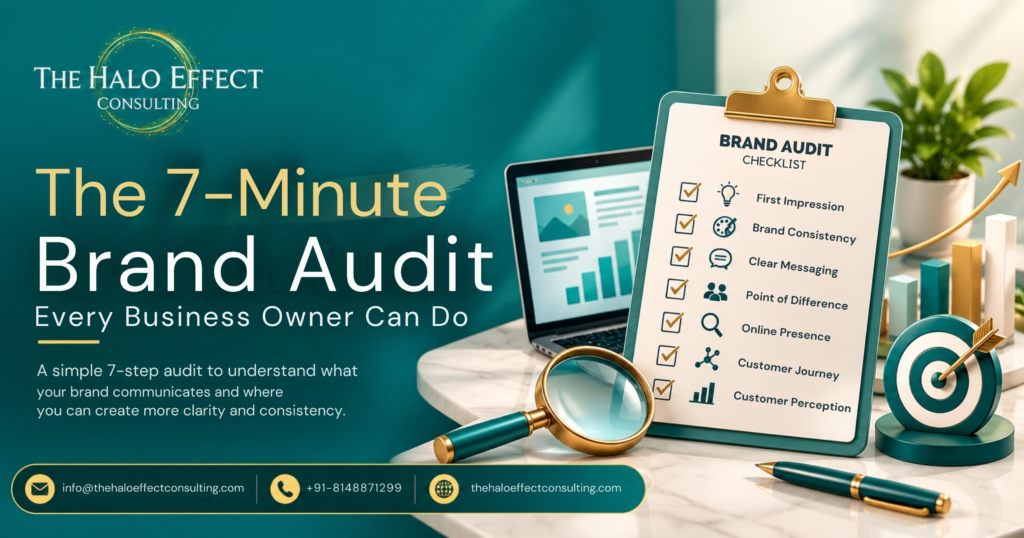
A brand audit helps you step back and look at your brand from the customer’s perspective. The Halo Effect Consulting helps businesses identify gaps across brand strategy, positioning, messaging and customer touchpoints. Before going deeper, this simple seven-minute checklist can help you see what is clear, what feels disconnected and what may need a closer look.
What Is a Brand Audit?
A brand audit is a structured review of how a business is presented, communicated and perceived across its customer touchpoints. It can cover brand identity, messaging, positioning, website, online presence, consistency, customer perception and competitive positioning.
The purpose is not to change everything about your brand. It is to understand what is working, where the gaps are and whether the way your business presents itself still reflects where the business is today.
Why Is a Brand Audit Important?
Brands change as businesses grow. New services are added, target audiences evolve, websites are updated, different people manage social media, and messaging changes over time.
Without regular review, these changes can create small inconsistencies that eventually make a brand harder to understand.
A brand audit helps you identify:
- What your brand communicates clearly
- Where your messaging feels inconsistent
- Whether your positioning still reflects the business
- How your brand appears across different touchpoints
- What customers may be misunderstanding
- Where competitors are positioned more clearly
- Which areas need attention first
7 Key Areas to Review in a Brand Audit
1. Brand Messaging: What Does Your Business Communicate?
The Five-Second Test:
Start with your website or main business profile and look at it for just a few seconds. Without scrolling further, consider what a new visitor would understand about your business, who you serve and what you offer. Your headline, supporting message, visual and call to action all contribute to this first impression.
Before you move on, ask yourself:
- Is the business easy to identify?
- Is the main offering clear?
- Is it obvious who the business is for?
If the answer is unclear, your brand messaging may need a closer look. You are not trying to explain everything on the first screen; you are checking whether the most important idea comes through clearly.
2. Brand Identity: Does Your Brand Look Consistent?
The Recognition Test:
Now look at your website, social media profiles, Google Business Profile and other customer-facing materials together. Do they feel like different touch-points of the same business, or do they create completely different impressions?
Look at a few basic elements:
- Colors and typography
- Imagery and visual style
- Tone of communication
- Key messages
- Business information
Your brand identity includes more than your logo. These elements do not need to look identical everywhere, but there should be enough consistency for customers to recognize the connection.
3. Brand Positioning: Is Your Business Easy to Understand?
The Explanation Test:
Read your About section and service descriptions as if you were discovering the business for the first time. Then try to explain what the business does in a couple of simple sentences, without using industry jargon or listing every service.
Pay attention to whether you can clearly communicate three things:
What you do → Who you help → What you help them achieve
If that explanation becomes complicated, take another look at your brand positioning and messaging. A business can have several services and different audiences while still having a clear central idea.
4. Brand Differentation: What Sets Your Brand Apart?
The Difference Test:
Spend a few minutes looking at two or three competitor websites. Focus on their messaging rather than their colors or design. Notice the problems they talk about, the benefits they highlight and the ideas they repeatedly use to describe their businesses.
Then compare that with your own positioning. Your difference could come from your:
- Expertise or experience
- Specialization or niche
- Approach or methodology
- Target audience
- Way of solving a particular problem
The important question is whether customers can actually recognize that difference. Something can be genuinely different about your business and still be difficult for customers to notice if it is not communicated clearly.
5. Digital Brand Presence: What Does Your Online Presence Say?
The Google Test:
Search your business name on Google and look at the results from a customer’s point of view. Your website is only one part of what they may encounter, so look at the wider picture rather than focusing on a single result.
Check what appears across:
- Google Business Profile
- Customer reviews
- Social media profiles
- Business directories
- Images and other brand mentions
Look for consistency in your business name, services, descriptions, contact information and visual identity. Your online brand presence is shaped by everything customers find about your business, not only the content you publish yourself.
6. Brand Consistency: Does the Experience Feel Connected?
The Customer Journey Test:
Imagine someone discovers your business through Google. They visit your website, check your social media, read a few reviews and eventually contact your team or look at your sales material.
At each stage, they are forming an understanding of your business. The question is whether that understanding remains consistent as they move from one touch-point to another.
Pay attention to:
- Brand voice
- Key messages
- Service descriptions
- Visual identity
- Business information
- Promises and claims
Brand consistency does not mean repeating the same content everywhere. It means giving customers a connected experience as they move through different parts of your brand.
7. Customer Perception: How Do Customers Actually See Your Brand?
The Reality Test:
Now look at a few customer reviews, enquiries, testimonials, comments or frequently asked questions. Instead of focusing only on ratings, pay attention to the words customers use when they talk about your business.
Look for patterns in what they:
- Appreciate about your business
- Ask about repeatedly
- Seem to misunderstand
- Remember most clearly
Then compare those observations with the way you describe your brand. There can sometimes be a difference between the brand you want to communicate and the brand customers actually experience. That difference can point towards an area that deserves closer attention.
What Is the Brand Audit Process?
A quick brand audit can begin with seven simple steps:
1. Define what you want to evaluate
Know what you are trying to understand before reviewing everything.
2. Gather your brand touchpoints
Bring together your website, social profiles, Google presence, sales material and other customer-facing assets.
3. Review your messaging and positioning
Check whether customers can understand what you offer, who you serve and why it matters.
4. Review your visual identity and consistency
Look for differences in colours, typography, imagery, tone and core information.
5. Look at customer perception
Use reviews, enquiries, feedback and conversations to understand how the brand is actually being understood.
6. Compare your competitive positioning
Identify where competitors are stronger, clearer or more distinctive.
7. Prioritise the findings
Separate the issues that need immediate attention from those that can be improved later or investigated further.
What Should You Do After a Brand Audit?
Once you have reviewed your brand, separate your findings into three categories:
Fix Now
Issues that directly affect clarity, trust or customer experience.
Improve Next
Inconsistencies or outdated elements that should be addressed but are not immediately critical.
Investigate Further
Areas where you need customer research, competitor analysis, analytics or a deeper brand assessment before making a decision.
The purpose of an audit is not to make your brand look different for the sake of change. It is to help you understand what needs to change and what is already working.
When Is It Time for a Brand Audit?
You do not need to wait for a complete re-brand to review your brand. A brand audit can be useful whenever the business has changed but the way it is presented has not fully caught up.
Consider reviewing your brand when:
- Your business has expanded into new services
- Your target audience has changed
- Your current positioning no longer feels accurate
- Your website or visual identity feels outdated
- Different platforms communicate different messages
- Customers frequently misunderstand your offering
- Competitors appear more clearly positioned
- You are considering a re-brand
- You are entering a new market
Your brand should reflect the business you are building today, not simply the business you started with.
Ready to Look at Your Brand More Closely?
If your quick audit has left you with more questions than answers, it may be time to look at your brand as a whole rather than one platform at a time.
The Halo Effect Consulting helps businesses bring together brand strategy, positioning, messaging and customer touch-points to understand how the brand is being experienced and where it can become clearer and more consistent.
Start a conversation with The Halo Effect Consulting if you are ready to take a closer look at what your brand is communicating.
Phone: +91 7397778891
Email: info@thehaloeffectconsulting.com